Sunday, January 04, 2009
Wednesday, October 15, 2008
Paper Dress - History of a Ready to Tear Invention . . .
From Guest Blogger, Samantha Marcelo of inventorspot.com, an article on the Paper dress:
* * * *
“The 1960s were a remarkable period in history for many reasons, and the invention of new fashion ideas was one of them. Some are still around today, such as the mini skirt, but there was one fad from the '60s that we may never see again - the paper dress.
In 1966, Scott Paper Company invented the paper dress, intended as a marketing tool. For one dollar, women could buy the dress and also receive coupons for Scott paper products. The paper dress, shapeless and unattractive, wasn't an invention meant to be taken seriously, but women surprised the company by ordering half a million of these dresses in under a year. It might sound surprising to us, but when you remember that this was a time in history that had just gotten used to disposable cutlery, plates and diapers, this new fashion was appealing. People were demanding more convenience and instant gratification. What was more instantly gratifying than a dress you could hem yourself with only a pair of scissors, or a dress that could simply be thrown out if it got dirty?
As the trend took off, companies began to experiment with style and fabric, adding other materials to the paper to make a sturdier garment that could even be washed. Mars Manufacturing Company invented a wide range of paper dresses, from a basic A-line style to a paper evening dress to a full paper wedding gown, all for under $20. Other companies followed suit, inventing such things as paper slippers, paper bell-bottom suits and waterproofed paper raincoats and bikinis. There was even a paper dress invented that grew herbs when water was added. In their short history, paper dresses became more stylish than the original, patterned with '60s paisley and psychedelic prints. Some paper dresses were sold that could be decorated by the consumer. Even Andy Warhol got in on the trend, creating a design based on his famous Campbell's soup can print.
Paper dresses sounded like the next great invention - convenient, cheap and fashionable. So why aren't they around today? It certainly wasn't for lack of marketing. According to a Time Magazine article from 1967, "Sterling Paper believes in paper resort wear, the idea being that vacationers could buy paper clothes
at the hotel when they arrive, throw them away when they depart, thus eliminating packing and carrying heavy luggage." Paper dresses were also lauded in fashion magazines of the times. However, the physical limitations of a dress made from paper were too great to large up to critical acclaim. Despite efforts to invent a durable paper-based fabric, the dresses ripped too easily. Also, though some dresses had chemicals added to prevent them catching fire, repeated washings removed this protection.
Only a few years after the invention of the paper dress, the fad had become obsolete. It remains, however, a testament to the innovation of the '60s, a period in history known for its willingness to take risks and be daring.”
Paper Moon and other movies on paper . . .
She won the Oscar for her role back in 1973. I just love that movie.
http://www.imdb.com/title/tt0070510/
What other movies include Paper? Big budget movies and low budget foreign films:
The Paper (1994) directed by Ron Howard and starring Michael Keaton, Glenn Close and Robert Duvall.
Paper Dolls (2005) examines the lives of a group of transsexual Philippine immigrants who work as home attendants for elderly Israelis.
Saturday, March 01, 2008
Wednesday, October 03, 2007
Do It Yourself Paper Dresses

Pattern for Dress One: Model Femke
Directions for Dress One: Model Femke
1. Print out all the panels belonging to Model Femke and enlarge each page by 333%.
2. Carefully cut them out along the dashed line.
3. Begin with the front panel of the bodice. Fold pleats as indicated and fix by stitching at mark. Close the darts by folding the indicated lines into each other. Finish by stitching them together.
4. Prepare the back panel of bodice by sewing upper and lower part together. Cut a slit at the indicated line.
5. To complete the construction of the bodice, lay the printed side of the back panel over the printed side of the front panel. Sew shoulders and left side along the seam lines. Turn bodice right side out
6. To make the skirt begin by stitching the two panels together on the left side. Fold the pleats as indicated and stitch to fix along indicated marks.
7. Pin the skirt to the bodice by matching the marks on each respective section. Sewing the seam on the interior side, fix the bodice to the skirt. After completion turn dress right side out.
8. To make the drawstrings, fold paper along the indicated lines and reinforce the length with a straight stitch. Finish the dress by attaching the drawstrings to the indicated cross marks on the right hand side of the skirt with a short stitch.
Buy the Large sheets of Paper to make this fabulous dress.
Labels: paper art, paper crafts
"Mod" Paper Dress, circa 1967

Paper Dress, circa 1967
Donated by Mrs. Richard Johnson
During the 1960s, massive changes in society inspired young people to set themselves apart from the established order. A profusion of new materials, including plastics, metallic fibers, and even paper, were used to help break down old standards. This made for daring, shocking, and often frivolous fashions. The new, the wild, and the colorful were embraced and celebrated. Women of all ages raised their skirt hemlines in order to step out in the stylish mini-skirt.
The paper dress shown here demonstrates the "mod" look. The dress is complemented by Capezio "ballet" flats. The overlapping hippie movement utilized a more natural approach in order to achieve the back-to-the-earth fashions. When the two collided, they sparked the punk look of the late 1970s.
courtesy of the Wilmette Historical Museum: http://www.wilmettehistory.org/costumes/1967.html
Tuesday, October 02, 2007
Copy Paper Commercial - Very Funny!
That thing would not make sharp clear copies at that distance. Maybe he is amazed by how much paper she has wasted.
Labels: environmental paper, paper copy, paper games
Paper Machine Video - Making Paper
"feel the heat . . .hear the hard noise and experience the stress again by braking the paper in the machine! Every minute without production costs a lot of money"
Labels: paper industry, paper mills
NewPage to Buy Stora Enso North America in 2.5 Billion Deal
Under the terms of the deal, Stora Enso will receive approximately $1.5 billion in cash, a $200 million note, and a 19.9% equity interest (approx. $370 million) in the new company. In addition, NewPage will assume net liabilities of about $450 million.
The deal is subject to regulatory approvals and is expected to close during the first quarter of 2008.
"We are excited about the acquisition as it is clearly part of our strategic vision to lower our overall cost and accelerate our ability to achieve sustainable financial returns above our cost of capital," said Mark A. Suwyn, Chairman and Chief Executive Officer of NewPage. "This is also important in order to help us compete with illegally dumped and subsidized foreign imports."
The deal includes Stora Enso's papermaking operations in Biron, Kimberly, Niagara, Stevens Point, Whiting and Wisconsin Rapids, Wisconsin; Duluth, Minnesota; and Port Hawkesbury, Nova Scotia, Canada.
For the year 2006, Stora Enso North America generated $2.0 billion in revenue and an adjusted EBITDA of $295 million.
According to NewPage, during 2006, the combined company on a proforma basis would have generated $4.1 billion in revenue and an adjusted EBITDA of $583 million.
The combination is expected to generate approximately $265 million in annualized cost savings. "These cost savings combined with our increased scale will enable us to make further high-return investments in lower cost capacity, increase supply chain efficiencies and product availability and enhance environmental leadership," said Rick Willett, president and COO of NewPage.
"Today, both companies enjoy leading reputations for high-quality products and superior customer service, and we believe the integration will provide our customers with a stronger, more efficient platform for improvements to product and service quality as well as new product innovation," Willett added.
"This combination is very exciting for the SENA team due to the expanded scale and capabilities for our customers and a stronger platform for all of our employees," said John Gillen, president and Regional Manager of the North America Region for Stora Enso North America. "We're enthusiastic about working together with a NewPage team that shares the same cultural values of customer focus and continuous improvement through the engagement of all employees."
The sale of Stora Enso North America Inc., which comprises Stora Enso's publication and fine paper operations in North America, will reduce the Group's annual production capacity by 3.0 million tons and the number of personnel by 4,350. Stora Enso is retaining Corenso North American operations and the associated company Thiele Kaolin Company Inc. Corenso produces cores and coreboard for industrial use in various fields of business and Thiele produces china clay for the paper industry.
The new company will retain the NewPage name and will be headquartered in Miamisburg, Ohio.
NewPage, headquartered in Miamisburg, Ohio, is a leading U.S. producer of coated papers in North America. The company produces coated papers in sheets and rolls with many finishes and weights to offer design flexibility for a wide array of end uses. With more than 4,300 employees, NewPage operates integrated pulp and paper manufacturing mills located in Escanaba, Michigan; Luke, Maryland; Rumford, Maine; and Wickliffe, Kentucky; and a converting and distribution center in Chillicothe, Ohio. The mills have a combined annual capacity of approximately 2.2 million tons of coated paper.
Stora Enso Oyj is an integrated paper, packaging and forest products company, producing publication and fine paper, packaging board and wood products - all areas in which the Group is a global market leader. Stora Enso's sales totaled EUR 14.6 billion in 2006. The Group has some 44,000 employees in more than 40 countries on five continents. Stora Enso has an annual production capacity of 18.2 million tones of paper and board and 7.4 million cubic meters of sawn wood products, including 3.2 million cubic meters of value-added products. Stora Enso's shares are listed in Helsinki, Stockholm and New York.
Stora Enso North America is a leading producer of coated and supercalendered papers, and a premier producer of specialty papers. Other products include newsprint, elemental chlorine-free kraft pulp, totally chlorine-free mechanical pulp and recycled pulp from recovered paper. The company produces 3.0 million tons of paper annually and had revenues of $2.3 billion with about 4,350 employees in 2006.
SOURCE: NewPage Corp.
Labels: paper industry, paper mills, paper news
Georgia-Pacific Appoints New CEO and President and New Chairman of the Board
that Joe Moeller, 64, the company's chairman and chief executive officer,
will return to Koch Industries as vice chairman and a member of its board
of directors, effective Nov. 1, 2007. Moeller will continue as a member of
Georgia-Pacific's board of directors.
Jim Hannan, 41, Georgia-Pacific's president and chief operating
officer, will be promoted to CEO and president. Hannan joined
Georgia-Pacific in December 2005 as executive vice president and chief
administrative officer. He was named president and chief operating officer
in 2006.
Dave Robertson, 45, who currently serves as Koch Industries' president
and chief operating officer, is assuming the additional role of chairman of
Georgia-Pacific's board of directors. Robertson joined Georgia-Pacific's
board in 2006.
"Since joining Georgia-Pacific, I have been impressed with the talent
of our leadership team and the passion and commitment of all employees,"
Moeller said. "I have the utmost confidence in Jim Hannan and the strong
team leading Georgia-Pacific today. With this leadership, the company's
future prospects could not be more promising."
Hannan added, "I am honored to have had the opportunity during the past
couple of years to work directly with Joe, and all of us at Georgia-Pacific
thank him for all he has done for our company. This is a great company and
a great place to be. We're investing in our growth and success, and I'm
excited about leading the team into the future."
Headquartered at Atlanta, Georgia-Pacific is one of the world's leading
manufacturers and marketers of building products, tissue, packaging, paper,
cellulose and related chemicals. The company employs approximately 50,000
people at more than 300 locations in North America, South America and
Europe. The familiar consumer tissue brands of Georgia-Pacific Consumer
Products LP include Quilted Northern(R), Angel Soft(R), Brawny(R),
Sparkle(R), Soft 'n Gentle(R), Mardi Gras(R), So-Dri(R) and Vanity Fair(R).
Dixie Consumer Products LLC, a Georgia-Pacific company, manufactures the
Dixie(R) brand of disposable cups, plates and cutlery. Georgia-Pacific has
long been among the nation's leading manufacturers and suppliers of
building products to lumber and building materials dealers and large
do-it-yourself warehouse retailers, with brands such as Plytanium(R),
Ply-Bead(R) and Wood I Beam offered by Georgia-Pacific Wood Products LLC
and DensArmor Plus(R), DensGlass Gold(R) and ToughRock(R) offered by
Georgia-Pacific Gypsum LLC. For more information, visit http://www.gp.com.
Kimberly-Clark to expand consumer trials of recycled product lines
Kimberly-Clark Corp. announced plans today to expand its consumer trials of Kleenex Naturals brand facial tissue and Scott Naturals brand bathroom tissue and paper towels in the U.S.
The company said the products, which have been available in select Wal-Mart stores since late 2006, contain a mix of high-quality, post consumer recycled fiber and virgin fiber.
Gordon Knapp, K-C president of North Atlantic Family Care products, said in a statement the lines meet a growing interest from consumers who value recycled products but do not want to sacrifice quality or softness.
The Naturals brand line will be available in more Wal-Mart stores this month and be offered at a limited number of K-Mart stores as well.
Labels: paper tissue
International Paper heads to the wild Russian East
These remote northern Russian woods are also right next door to China, where demand for paper and consumer packaging for the country's booming middle class has far outstripped supply.
Closing the gap between the two is exactly where International Paper Corp. (IP) wants to be, positioning itself in Asia, where paper and board production is expected to surpass output in the languishing North American market by 2015.
In August, International Paper, the world's biggest paper and packaging company by sales, formed a 50-50 joint venture with Russian mill operator Ilim Group Holdings. If all goes well, one analyst predicts the deal could add almost 10% to the company's 2008 per-share earnings.
It's not a move without risks, PricewaterhouseCoopers analyst Craig Campbell said, citing potential political instability, poor infrastructure and a fractured market with numerous competitors. "But it does have potential," Campbell said. "Ilim is the biggest player, a smart player, with older mills that could benefit from new investment."
Indeed, International Paper agreed to invest $650 million in Ilim. The venture is expected to tap cash flow from operations and additional debt to sink another $1.5 billion into Ilim's four mills -- two of which are in western Russian -- over the next five years. International Paper has predicted the investment will eventually lift profits through equipment upgrades, allowing for greater capacity and high-product development.
Meanwhile, in pulp-starved China, International Paper has a 50% stake in Shandong Paper & Sun Coated Paperboard Co., which it purchased in December for $28 million. In addition to coated paperboard, Sun makes bleach board, used to package food and consumer staples like those used by International Paper's biggest customers, McDonald's (MCD) , Wal-Mart (WMT) , Cadbury-Schweppes (CSG) , Revlon (REV) and Johnson & Johnson (JNJ) .
The strategy hasn't been good for the stock, which currently trades at about $36, or 12.2 times analysts' average 2009 earnings estimate of $2.93 a share, as calculated by Thomson Financial. Rivals MeadWestvaco (MWV) and Weyerhaeuser Co. (WY) trade at 17 times and 20 times analysts' estimates, respectively.
Furthermore, International Paper sold almost all its North American timberland to raise $11.3 billion to help pay for the venture, along with its investments in Brazil and Eastern Europe. After paying off about $6.2 billion in debt and buying back about $1.4 billion in stock, that's still a lot of cash investors might not see again if the Russia-China gamble fails.
"The unknown is worrisome, sometimes for the right reasons," Chief Executive John Faraci told MarketWatch. But, he added, IP has been in western Russia since 1999. "We know how to do business there, and we've been successful."
J.P. Morgan analyst Claudia Shank said Faraci and International Paper already have had great success with similar operations in Europe, growing earnings before interest and taxes at its Kwidzyn, Poland, mill by 67% between 2001 and 2006.
The deal with Ilim is expected to close before the end of October, and International Paper has already appointed a new CEO there and placed several members on Ilim's board of directors and in key executive positions. Furthermore, Faraci said he anticipates additional cost efficiencies, not built into the value of the deal, between International Paper's Russian and Chinese operations.
China wants goods; Russia wants business
Double-digit economic growth has made China one of the world's hottest markets for paper and packaging products. And as long as its middle class continues to grow in hand with the country's rapid urbanization, demand for fast food, over-the-counter medication and other packaged consumer staples should keep growing.
China's paper mills and packaging plants are severely underdeveloped, with small "mom and pop" shops often using antiquated equipment, said Bruce Manchester, senior managing director at RSM EquiCo, a financial-services firm. That's a plus for International Paper, which has the capital and business structure needed to boost capacity, cut costs and grab market share.
The big challenge is securing a steady supply of pulp.
For the first half of 2007, China's pulp demand was up 15% from a year ago, according to data from the credit-rating agency Fitch. In the same period, U.S. pulp demand rose 7%, with much of the increase tied to shipments of recycled linerboard to China.
The Russian forest holds about 20% of the world's timber resources, by both area and volume, and nearly 32% of the world's commercially productive forest, according to Midway United Ltd., a Boston-based firm that has been logging timber in the country for about three years. More than half of that is in Siberia, which includes the Russian Far East.
The region is similar to Canada in size and population, with most residents clustered in the south near the China and Mongolia borders and along the Trans-Siberian railway linking Moscow to the Pacific port of Valdivostok.
About 65% of Siberia's timber grows in the desolate north, where permafrost and severe cold hamper road construction and settlement.
Russia's timber industry has been experiencing a re-emergence of sorts. Production fell off soon after the Soviet Union dissolved in 1991. Moscow has more recently been encouraging investment in the sector to upgrade Soviet-era equipment and to help diversify an economy heavily dependent on oil and gas production.
"It's an interesting time over there, and it's one of the last true frontiers for the timber industry," Midway United's director of operations, Murphy Vanderbilt, said. "The industry is pretty well developed, but it's in great need of capital improvements and infrastructure," Vanderbilt said, adding that most of the tree-cutting operations resemble old-fashioned logging camps.
The Forest Stewardship Council, which certifies what it calls sustainable forestry management, has said Ilim is ahead of other Russian companies in terms of operations upgrades, worker safety and environmental impact. Of about 25 million hectares of commercial forest in Siberia being managed, only about 6 million is FSC-certified, of which 4 million is leased by Ilim.
International Paper performed almost two years of due diligence before diving into the venture with Ilim, but in analysts' view the greatest risks are tied more to the political climate in Moscow than the physical challenges of Siberia -- most evident in Moscow's reassertion of national control over its oil and gas industry.
Several Western oil companies, among them Royal Dutch Shell (RDS.A) and BP PLC (BP) , have been forced to relinquish some operations to Russian counterparts after state officials accused them of failing to live up to the terms of their original production licenses.
©1997-2002 MarketWatch.com, Inc. All rights reserved. See details at http://custom.marketwatch.com/custom/docs/useragreement.asp.
Thursday, September 27, 2007
The Skinny on Chlorine Free Papers
Another common bleaching process in the paper industry is Elemental Chlorine Free (ECF), which is a bleaching agent that utilizes a pollution prevention technology to eliminate persistent, bioaccumulative toxic substances in mill waste-water. The bleaching agent is a derivative of chlorine called chlorine dioxide, which is less harmful to the environment than elemental chlorine. What this ensures is an environmentally safe method to bleach the paper without the harmful chemical effects of chlorine.
For more information on Chlorine Free paper, please visit this informative website: http://www.ciwmb.ca.gov/Paper/ChlorineFree/Default.htm
Labels: environmental paper, paper education
Wednesday, September 26, 2007
Staples calling all Specialty Paper Sellers, You Know Who You Are
Paper.com is very good at selling Specialty Paper and we have about 40,000 types online.
Staples sells "Specialty Paper" too, about $300mm per year. However, Staples defines specialty paper a bit differently. They are referring to anything that is not white and 8 1/2 x 11 as specialty paper.
It is interesting to me that we all define specialty paper so differently. For Staples it represents about 300 papers. For Paper.com it represents about 40,000 papers.
In fact, for Paper.com the most bizarre and unusual papers are probably specialty papers. Edible papers. Waterproof papers. Earth friendly papers. Handmade papers. Therhttp://www.blogger.com/img/gl.link.gifmal papers. Carbonless papers. Paper made of plastic, like Tyvek papers or Yupo papers which are synthetic papers for watercolor projects.
How about textured papers? We have laid finish, linen finish, , rough, smooth and supersmooth. Exactly how smooth does a paper have to be to be supersmooth?
Or, we can consider inclusions. Paper is usually made by pulping cotton or wood into a pancake batter substance that is sprayed on a screen like you would find on a screen door, but finer. Water drips through the screen and the fibers of the wood or cotton line up and bond together naturally so that when its dry, its paper. During this process it is common to drop leaves, flowers, and other items into the paper during the drying process so that these items become part of the paper. Each sheet of paper is unique. Paper.com sells thousands of these unique, specialty papers, both by the sheet or by the pack.
Here is today's interesting specialty paper, Stone Cinnamon, an embossed paper:

Labels: paper art, paper crafts, paper miscellaneous, Paper.com
Tuesday, September 25, 2007
Leonardo DaVinci's Favorite Brand of Paper is Fabriano Medioevalis
You can find the citations at The Paper Project website:
1268 . . . Paper made at Fabriano, where it is still being made . . . Papermaking reaches Southern Italy, where until recently, some of the oldest handmade paper mills in Italy were operating near Amalfi, in the Naples area. First mention of the Fabriano, Italy, paper mills (1276). First mill established in Bologna, Italy (1293).
Paper.com sells Fabriano Medioevalis papers today.
In addition, Paper.com sells paper from the Cartiere Magnani paper mill in Pescia which has been producing paper since 1404.
How Much Paper Is There In One Tree?
It depends on the size of the tree. According to the Boise Cascade Corporation a cord of wood measuring 4 feet by 4 feet by 8 feet—or 128 cubic feet—produces 90,000 sheets of bond-quality paper or 2,700 copies of a 35-page newspaper.
Labels: environmental paper, green paper, recycled paper
Friday, August 17, 2007
Paper CD Case
You'll need this after you burn a copy of High School Musical 1 or 2.How to fold the paper case:
1. Fold the left and right sides (lines labelled "1" and "2").
2. Fold the bottom edge up to the line labelled "3". Then fold it back. This part will be the pocket.
3. Fold the top edge down to the line labelled "4" and then fold it back. Then fold the top edge down the the line labelled "5" and then fold it back. This will make the spine and top flap.
4. Spread the sides of the pocket to the sides to create "wings". Beginners can do this by folding lines "6" and "7" (first wing) and then lines "8" and "9" (second wing). Or, fold "6" and "8" and then "7" and "9". The fold lines may be off slightly depending on your printer.
Steps 5-7
Labels: paper miscellaneous
Saturday, July 28, 2007
DIY: Paper Wall Hanging
30 sheets papyrus and/or handmade paper cut to desired size (maybe try these or these maybe)
100 split-ring key tags
Craft knife
Metal straightedge
Scotch tape
Hole punch
Pencil
Ruler
36"-long wood lath or dowel
2 cup hooks
2 eye hooks
10 pieces of 4"-long raffia
2 pieces of 24"-long raffia
Note: These directions will yield a decorative panel that's 36" x 60", 5 panels across by 6 panels high. To make a larger or smaller panel, simply add or subtract rows until the desired size is achieved.
Directions:
1. Measure and cut the papyrus or handmade paper to desired size. We used 8" x 10" as our size.
Source
Labels: paper crafts
Friday, July 27, 2007
Paper Math
How to determine ream weightsTo determine ream weight (500 sheets) of any given size sheet, multiply the square inches in the given size by the given basis weight; divide the result by the square inch area of the basic size.
sheet size x basis weight / area of basic size = ream weight
Example: Find the ream weight of a sheet of 70lb. text paper.
23 x 35 x 70 / 25 x 38 = 56,350/950 = 59.32 lb. ream weight
How to determine M weights
M weight is the weight of 1,000 sheets. The M weight can be obtained by multiplying the ream weight by 2.
ream weight x 2 = M weight
Price per thousand sheets
cwt. price x M weight / 100 = price per 1,000 sheets
Source: Mohawk Paper
Labels: paper education
Thursday, July 26, 2007
Sarcasm Aside: Paper
Nice post on some important paper, such as Andy Warhol's Souper Dress, the first folio of Shakespeare, and the Frank Gehry paper lamp. So cool.
Thursday, July 19, 2007
The secret to Hokage?
I've watched 400 hundred hours of Naturo this summer and found these papers from Japan inspiring. This sheet features black/grey/gold umbrellas. It's a silkscreen paper with a design originating from famous Yuzen patterns.
This red wave pattern may as well come from the hidden village of leaf.
These papers are Black Ink Products and distributed by Graphic Products Corporation.
Wednesday, June 20, 2007
Paper and Bureaucracy
Electronic records are on the rise, but paper’s here to stay
Agencies are busily working to digitize vast troves of records they produce each year, but don’t count on a wholesale shift from boxes to computer chips.
Hard copies are here for the duration, experts say.
"Paper is not going out of style, and it’s not going away," said Matthew Eidson, director of operations at the National Archives and Records Administration’s Suitland, Md., records center.
In fact, even as electronic records increase, the quantity of paper produced by agencies is also growing, records managers said. And in the near future, that will likely continue.
Source
Labels: paper news
Monday, June 18, 2007
Pope's Hat Flying Napkin Paper Airplane

Pope's Hat Flying Napkin paper airplane
Well back to airplanes... this design looks like a Pope's hat, uses origami paper cut into a square and you do the fold-overs only on one half. The flight path is unique- it drops almost vertically for 10' or so and then glides a long long way. Perfect for flying out the window.
It is best thrown overarm with the heavy end first. It can be made to spin like a stunt plane. When the plane is cut in half you make one of the curled up sides more strongly bent than the other. This will give different drag on either side and cause the plane to spin.
Labels: paper copy, paper crafts, paper games
Thursday, June 14, 2007
Astrobrights®
Here are some of my favorties:


Labels: paper
Thursday, June 07, 2007
If a tree falls in the woods...
Paper is an aggregated web of vegetable cellulose fibres usually prepared from wood pulp. The fibres in this planar web are bound to each other by a kind of bonding known as hydrogen bonding.
The internal structure of paper can be described as follows. There is a distribution of the fibre sizes; the finer ones interpenetrate into the web of larger ones and small clusters of these hold together the larger ones and so on.
Read more
Labels: paper education
Wednesday, June 06, 2007
Where in the world is Mr. Paper?

Mr. Paper is a scrapbook and papercraft(ing) fiend. Last week he was mildly irritated (spewing pulp and whatnot) because he couldn't find stickers licensed by Disney for World Showcase in EPCOT.
Fearing the couch pit, the Paper.com support staff mobilized and found a swanky solution! You can use stickers by Jolee's for Mexico, Italy, and the USA. While not officially licensed Disney stickers, they do feature most of the landmarks from World Showcase.
Did you stay at the Polynesian? Use the Hawaii stickers to add flair to that scrapbook page.
As an aside...
I saw pictures of Mr. Paper binging at the luau and those stickers would serve as a nice distraction.
Labels: paper crafts
Friday, June 01, 2007
World Rock Paper Scissors Society - Home
Paper.com would like to recognize this fine site.
"What separates RPS from other sports is the extent to which gamesmanship is a factor in even the most casual play. Effective gamesmanship allows the player to deceive an opponent into making a predictable throw or have them miscalculate one’s next throw. The key to successful gamesmanship is never to let the opponent realize that he is being manipulated."
The 7th Rock, Paper, Scissors World Championship
Does ESPN cover that? Paper.com would like to sponsor this event. Are there sponsorship opportunities available? You know who we're rooting for.
Labels: paper games
limit the use of toilet paper to one square of tissue per lavatory visit...
Fri, June 1, 2007
Doing your part to save the planet seems a whole lot easier if you're a celebrity. Or a heavy drinker.
By MARK BONOKOSKI
"We shall require a substantially new manner of thinking if mankind is to survive."
-- Albert Einstein
The Governator, green in celebrity, has now come and gone, leaving the message that the collective "we" can renew our planet's climate.
Before Arnold Schwarzenegger, it was pop rocker Sheryl Crow, once engaged to eco-friendly Tour de France pedaller Lance Armstrong, who had been putting the chill to global warming by using her now-completed tour of U.S. colleges to engage young minds into thinking of easy ways to leave a smaller environmental footprint, the latest catchphrase for living green.
One of her ideas, posted on her blog, was to limit the use of toilet paper to one square of tissue per lavatory visit.
Agence France-Presse picked up on that story PDQ, and blew it around the world in a cybersecond, forcing Ms. Crow to explain to the gullible the next day that she was only joking.
Thank God for that.
Trust me, it is not as easy as it sounds.
BIO BUS
Sheryl Crow had been travelling the campus circuit in her de rigeur bio-diesel bus with global warming activist Laurie David, who was also the producer of the Academy Award-winning An Inconvenient Truth, the now-ubiquitous documentary film based on former U.S. vice-president Al Gore's supposed 30 years of research into greenhouse gases.
And, leading up to April's Earth Day celebrations, Sheryl Crow and Laurie David appeared to be in 100 places at once -- spreading the message on every medium possible.
This, of course, was good -- just as it is good that Ms. Crow recently became an adoptive mother, another celebrity in-thing.
The Einstein quote attributed atop this column, by the by, was lifted off Ms. David's blog, thereby employing at least two of the four Rs proposed by Environment Canada -- reuse, and recycle.
Save the world. Pass it on.
It was while lugging a collection of empty wine bottles to the beer store the other day -- all to save the world and reclaim the deposit foisted upon us by the Liberal government of Ontario Premier Dalton McGuinty -- that I happened to hear a public service announcement on the radio about Alcoholics Anonymous.
And, because a columnist's mind is always in gear, it crossed this one's mind that AA is probably one of the least-recognized environmental groups on the entire planet. This comes at the heels of Toronto Mayor David Miller's recent whine that Toronto stands to lose millions of dollars to the new provincial deposit-return program for wine and liquor bottles because there will be less blue box content to sell to the glass market.
After analyzing just two months into the returns program, Toronto's acting manager of solid waste management, Geoff Rathbone, declared there was already a 50% to 80% drop in the amount of glass tonnage collected by the city.
Imagine, however, the tonnage that would have been lost if all those alcoholics in Alcoholics Anonymous were still drinking, and had been contributing like saints to the blue box program? The city would have to file for bankruptcy.
And imagine, too, how high the landfill would have been if those same AAs were still drinking at a time prior to the blue box's invention?
All this might seem quite ludicrous, of course, but, then again, Sheryl Crow had to return to her blog to tell her audience that she was only kidding about using one square of toilet tissue per lavatory visit after Agence France-Presse had the hip people of the world literally bending over backwards as they attempted to follow the singer's suggestion.
115,000 MEMBERS
Because it has never kept formal membership lists, mainly because anonymity is sacrosanct, Alcoholic Anonymous' head office out of New York estimates on its web site that there are nearly 6,500 registered AA groups in Canada, with approximately 115,000 members. Because of the anonymity factor, however, it could be double that.
In the GTA, according to the head office here, there are at least 15,000 active AA members who, if one entertains the premise of them suddenly going back on the grog, would unquestionably be stretching the returns section at the beer stores to their limit, or filling the landfill sites to capacity with their oft-secretive daily consumption of wine and spirits.
These numbers, therefore, are numbers that cannot be ignored, especially when no Einstein is needed to indicate their economic and environmental impacts are far from insignificant. Yet, ignored they seem to be.
A few weeks ago, for example, this newspaper asked our federal leaders what they are doing in their personal lives to leave a smaller environmental footprint. This, of course, was before Ontario Environment Minister Laurel Broten suggested we all flick off.
Prime Minister Stephen Harper and his environment minister, John Baird, refused to play along with the Sun survey -- shame on them -- but the rest of them did, with Liberal leader Stephane Dion, the NDP's Jack Layton, and the Green party's Elizabeth May getting high marks from the Sierra Club of Canada for their commitment to reducing greenhouse gases.
All three, believe it or not, claim they actually turn off the bathroom tap while brushing their teeth, undoubtedly brushing with eco-friendly baking soda, one can only presume.
And all three, of course, recycle their glass, although the type of glass they recycle was never broken down.
Did some of that glass -- most of it? -- come with California vineyard labels, as was being pressed this week by Arnold Schwarzenegger? And, if they did, were they returned for refund, or relegated to the blue box to assist their respective city's bottom line? These questions were never asked nor therefore answered.
Elizabeth May also said the only paper in her entire house is toilet paper, and that it is 100% recycled. She did not say, however, if it was also reused. Or if she used only one square at a time.
It's tough questions such as these that most often never get asked.
Thursday, May 31, 2007
Paper.com Listed In The Top 500 Retail Internet Sites
Selling over 30,000 types of paper, Paper.com has been listed as one of the Top 500 Internet Retail Sites. John Engel, Founder and President of Paper.com states, "I think this is tremendous recognition of all the hard work Paper.com has done assembling a unique assortment of paper products from around the world, from literally dozens of manufacturers ranging from office supplies to scrapbooking and stationery. Paper.com has brought all of these together into the largest paper site on the Internet, and this award demonstrates that Paper.com must be number one in our industry for customer service and selection of paper products at a competitive price." Paper.com has a wide selection of different paper products that suits every customer's need: office, school, scrapbook, invitations and more. Customer support services are readily available via phone, live chat and email. There is no doubt that Paper.com is one of the top online retail sites.
Copy me if you can...

Abagnale's Watermark Signature on High-Security Paper by Standard Register Will Help Thwart Document Crime, Check ForgeryPaper.com offers security/safety papers made by Georgia Pacific. Once a document is printed on the security paper if a copy is made a basket weave pattern will appear on the copy to indicate its originality. We've experimented with the product around HQ and it's neat (to borrow a word from the 50s) technology. I'm always astounded at how much innovation there is in this venerable industry.
DAYTON, Ohio, May 30 /PRNewswire-FirstCall/ - Frank Abagnale, the former con artist turned worldwide document security consultant, believes criminals attempting to copy, alter or steal checks or other original documents will be immediately deterred by a new high-security watermark safety paper bearing his name.
Abagnale, whose youthful exploits as a forger and imposter were depicted in the motion picture Catch Me If You Can, and Standard Register, a document services company and a leading provider of document protection technologies, created the paper, which can be used for checks, registrations, titles, gift certificates, college transcripts, entrance passes, tickets, vouchers and coupons - key targets for document fraud and crime.
Read more
Georgia Pacific Security Paper 8 1/2 x 11 #24 (500 Sheets) in Blue, Green, Grey and Yellow.
Labels: paper innovation
Tuesday, May 29, 2007
Hobbies | Scrap mania | Economist.com
Labels: paper crafts, paper profit
Announcing the Paper.com Affiliate Program...
http://ewealth.com/showthread.php?t=11349
http://affiliateguide.com/forum/viewtopic.php?t=1648
http://affiliate-marketing-forums.5staraffiliateprograms.com
http://im4newbies.com
http://www.revenuesource.com
Labels: paper profit, Paper.com
Paper.com Announces New Affiliate Program
Paper.com announced today the start of a new online affiliate program utilizing AffiliateTraction’s TrackAssure affiliate software as an addition to current advertising efforts.
A leader in art, office and educational paper supplies since 2003, Paper.com has served as a comprehensive source of consumer and corporate paper products such as greeting cards, wedding invitations, business cards, office supplies, stationary, envelopes, graph paper, transfer paper, photo paper, printable stationary and more. Paper.com claims to have over 8,000 types of paper in stock and available for immediate delivery.
According to Paper.com’s John Engel, the choice to start an affiliate program was a logical extension of current efforts. “An affiliate program allows us to extend our reach to new audiences without the time and effort involved in negotiating advertising purchases. AffiliateTraction’s services were very attractive to us, because they offer a comprehensive solution to affiliate marketing that includes software, promotion and management.”
According to Greg Shepard, CEO of AffiliateTraction, an affiliate program allows anyone to earn commissions for their efforts that result in sales. “It is very simple,” says Shepard. “Anyone can be an affiliate. Even without a website, affiliates can earn commissions through a simple website link we provide. The link can be e-mailed to friends, shared in online discussions, printed on business cards or flyers, and more.”
Mr. Shepard also made clear that AffiliateTraction offers help to those without experience in affiliate marketing. “Someone with no experience whatsoever can make money, and with the proper knowledge one can earn a healthy income,” says Shepard. “Best of all, we offer all of our affiliates help in implementing their promotional efforts through valuable tools, online tutorials and support by phone and email.”
Affiliates who sign up for the Paper.com affiliate program will earn a 10% commission on all sales they refer and are paid monthly when earnings have reached $25.00 or more. The Paper.com affiliate program is also configured so that even if a visitor is referred and does not return to the site to purchase anything for up to a year, the affiliate is still credited with the commission.
For more information about the Paper.com affiliate program, visit http://affiliates.paper.com
For more information about Paper.com, visit http://www.Paper.com
For more information about AffiliateTraction’s services, visit http://www.AffiliateTraction.com
Labels: paper profit, Paper.com
PAPER CALCULATOR
This shows how to multiply a three digit number by another three digit number by using lines and dots on a paper. I have never seen this done before, but it is an interesting trick.
Labels: graph paper, paper games, paper math
Rock/Paper/Scissors Peace Conference
That rock isn't so tough. I think paper can take him. They should have sent in a heavyweight paper, maybe a 300gsm Crane's Lettra. Instead, this is clearly a flyweight paper...
"I will take that as a motion that we can execute Paper..."
Labels: paper games
Monday, May 28, 2007
Picture (er, Paper) This!

Fold your own paper pinhole camera.Feeling a bit macabre? Try this papercraft.
The legendary Dirkon pinhole camera template was first published in Czechoslovakia in 1979. Graphic designer David Balihar had the text translated into English so it would be accessible to all fans of this camera technique.
Source and PDF.
Related
Paperinside.com is a blog devoted to paper toys! Here's another.
Are you a Disney fanatic? The Disney Experiece sells paper kits modeled after park attractions.
Labels: paper crafts
Holy Pink Batman!
Art installation or gaudy tomfoolery?
Labels: paper miscellaneous
Friday, May 25, 2007
Future's So Bright, I Gotta Wear Shades
Before You Choose Paper BrightnessWinston's Favorite Bright Paper
How white is white? In terms of paper, there are many different levels of whiteness or brightness. Paper brightness affects the images printed on the paper, especially the vibrancy of the colors.
Measuring Paper Brightness
The brightness of a piece of paper is typically expressed on a scale of 1 to 100 with 100 being the brightest. The multipurpose bond paper used in copy machines and desktop printers generally has a paper brightness in the 80s. Photo papers are normally in the mid to high 90s. However, manufacturers often use terms such as Bright White or UltraBright instead of numbers. These labels can be deceiving and not truly indicative of the brightness or whiteness of the paper.
Source
Mohawk Strathmore Pure Cotton 24# - Bright White - 8 1/2 x 11
I have a sweet spot in my heart for Mohawk after touring their mill in upstate New York.
Labels: paper education
Project Iraqi Kids
TV Lions Club
TV Kiwanis
Tellico Lake Rotary
The TV Polish Heritage Club
The TV Retired Military Club
Knights of Columbus of St. Thomas the Apostle Catholic Church
You can also take part in this special mission by donating a Paper.com Gift Certificate to the American Legion to buy the school supplies including backpacks, soccer balls, soccer uniforms and inflating pumps. Let's help our GI's help these kids!
Paper.com Robot Insurance

I found this image here. In addition to paper robots, the site features other cool toys and spaceships made of paper. The paper robot looks like the new imagery used by Finch Paper that we saw at the On Demand Show in Boston.

Finch Papers from Paper.com
Finch Color Copy 24# Writing 12 x 18 - Bright White
Finch Laser 24# Writing - 8 1/2 x 11 - Bright White
In case you're wondering...
Paper.com carries Old Glory Robot Insurance.
Labels: paper crafts, paper miscellaneous
Neenah Paper Joins the Chicago Climate Exchange
ALPHARETTA, Ga., May 24 PRNewswire — Neenah Paper, Inc. (NYSE: NP), the country's foremost premium paper manufacturer, has joined the Chicago Climate Exchange (CCX(R)). CCX is the world's first and North America's only voluntary but legally binding greenhouse gas emissions reduction, registry and trading program. By joining CCX, Neenah Paper has not only committed to tracking and reporting carbon dioxide emissions, but also to achieving a six percent reduction by 2010 versus their baseline. Other well known member- companies include Rolls-Royce, Ford Motor Company, DuPont, Eastman Kodak and Intel.Neenah Products available from Paper.com.
Mr. Paper Favorites:
Neenah Classic Linen 24# Writing - 8 1/2 x 11 - Haviland Blue
Neenah Classic Linen 24# Writing - 8 1/2 x 11 - Sage Green
Neenah Environment 80# Cover - 8 1/2 x 11 - Sedona Red
Neenah Classic Crest 24# Monarch Envelopes - 3 7/8 x 7 1/2 - Potomac Blue
Labels: environmental
Thursday, May 24, 2007
Wow, that is a really really big wedding!

Cranes Field Trip and Porsche's Mystic 137.jpg
Originally uploaded by paper_dot_com.
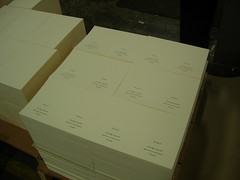
With 12 invitations to the sheet and maybe a four foot stack of invitations showing I'd say that the guest list for this wedding has to include at least 20,000 people.
Imagine how big the cake is!
Seriously, if you are planning a really really big wedding the cost of the fine cotton invitations are probably the least expensive part of the wedding but perhaps the most important.
If planning a wedding of this size, make sure you call Paper.com
Cranes Fine Stationery Being Assembled

Cranes Field Trip and Porsche's Mystic 135.jpg
Originally uploaded by paper_dot_com.
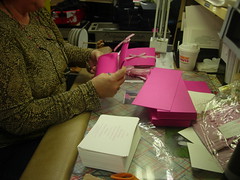
taken during our field trip to Crane's Paper in Massachusetts. This famous paper mill has been providing paper to the U.S. Treasury for the last 200 years but is probably most well known for their fine stationery. Here, in Massachusetts each order is hand picked and assembled. Each bow and ribbon is hand applied. We do things the old fashioned way and that's ok.
Cotton Slurry

Esleeck-Pics-011
Originally uploaded by paper_dot_com.
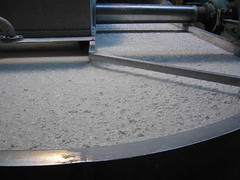
paper is 99% water at this stage. It is "sprayed" onto a screen, the water drips out, and voila you are left with high quality cotton writing paper. Sure, there's a little bit more involved, but if you've gotten this far you're almost home...
Wallpaper

post-it-1
Originally uploaded by paper_dot_com.
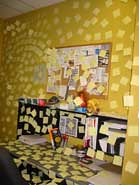
um, Scott, can you pick up some more Post-Its? We seem to be running low.
Recycling Paper in the Rainforest?

DSCN2231.JPG
Originally uploaded by paper_dot_com.
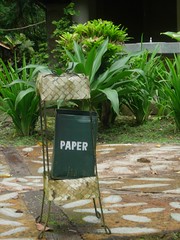
the paper recycling can in the Phillipine "jungle". I like the contradictions here. While the can is clearly labelled for paper only, it is slightly askew, on wobbly legs, with a bit of a roof and platform, both woven. The roof keeps the rain out. (after all its in a rainforest)
Mr. Paper?

Is this a picture of Mr. Paper? The identity of Mr. Paper is the one question we're asked most frequently. Frankly, none of the contributors to this blog have ever seen Mr. Paper. He communicates with us using [warning: shameless promotion plug] the many fine stationery products available from Paper.com.
Labels: paper miscellaneous
Monday, February 26, 2007
Danger, Will Robinson
MOTORISTS were delayed after a lorry collided with a car and shed its load of paper yesterday.
The large articulated lorry struck a car at 12.45pm on the London-bound A2, around 200 metres from the junction with the M25.
Read more
Labels: paper miscellaneous
Friday, February 09, 2007
Greenward Shift
MONTREAL, Feb. 8 /CNW/ - Environmental publishing advocates Markets Initiative released its Environmental Leadership in the Paper Supply Chain report today to coincide with Paper Week. The report is the first comprehensive review of the "greenward" shift that is taking place within Canada's publishing industries and other major paper consuming sectors across North America.
"Trends show that there has been a marked increase in market demand for papers free of endangered or intact forests such as Canada's Boreal," said Nicole Rycroft, Executive Director, Markets Initiative. "Increasingly informed and sophisticated corporate consumers are driving mills to develop new papers with strong environmental performance. Canadian paper producers that rise to this challenge are gaining significant competitive advantage. Paper companies that take the old pathway stand to lose market share."
More
Labels: environmental
Thursday, February 08, 2007
Paper Jesus
image of paper Jesus and friends
Wednesday, February 07, 2007
Halfbakery: Flash Paper Dress
Bring back the paper dress
(+12, -6)
(+12, -6) [vote for,
against]
The paper dress was invented in the 60's, and became quite fashionable. They were cheap and disposable - truly the fashion of the future. Well, at least until they realized that flammability was an issue. At the time the solution was to use flame-resistant materials. I assume this was too costly or toxic, as they quickly died off.
I propose we work in the other direction. Make them more flammable. In fact, make them so flammable that the heat put out by the time the entire thing has burned is very low - hopefully making them not very dangerous.
Issues:
Practical jokes. Not sure how to get around this one, except perhaps have it leave a coherent ash.
Flammability of hair. If the thing doesn't burn fast enough, your hair might. If the material has a low enough energy content, this may not be a problem.
Worldgineer, Jan 19 2005"
VerifiedVoting.org : demanding a paper record of every vote
Article in Support of Paper Based Voting Machines
Guardian Unlimited | Comment is free | In praise of... paper
Monday, February 05, 2007
Sierra Mist Rock Paper Scissors
This is an older commercial also featuring Rock, Paper, Scissors. Mr. Paper likes it better because paper finally beats scissors...
Tuesday, January 23, 2007
Erasable paper on forefront of recycling
Friday, January 19, 2007
Falling Paper - On tumbling, fluttering, Paper Airplanes and objects dropped in Swimming Pools
Falling Paper - Research - Z. Jane Wang Research Group
I grew up in Stuyvesant Town, New York City on the 8th floor and I put alot of paper airplanes, paper blimps and paper helicopters out the window in an effort to understand the art of falling paper. This study shows us in a graph and a movie how paper falls. Both tumbling and fluttering should be familiar to the paper airplane enthusiast.
I love these psychedelic movies showing the currents of air on the two types of falling paper.
Also, anybody who spends alot of time in a swimming pool should be familiar with these motions. Every time I drop something in the pool I see either the tumbling or fluttering action described in these studies.
Paper Innovation
Domtar launched the first antimicrobial office paper available in North America. Designed to protect paper against the growth of bacteria, odors, fungus, mold and mildew, this product is specially treated with a silver compound that kills most bacteria that come into contact with it. Although conceived for general office use, the paper's unique characteristics make it ideal for the healthcare, laboratory, hospitality, education and governmental sectors.
Read more
Saturday, March 11, 2006
Don't Bet Against Paper (He Lost With Scissors)
SARASOTA, Fla. - It all came down to this: Jason Wood threw a 'rock,' crushing Erin Smith's 'scissors' and earning him a trip to Las Vegas.
Wood, a 34-year-old server at an oyster bar, emerged from a field of 29 competitors to win the southwest Florida regional finals of the 'Rock, Paper, Scissors' tournament Thursday night at a local country music nightclub, the Sarasota Herald-Tribune reported in Friday's editions.
Now he's off to Vegas to compete in the national tournament and a chance to win $50,000.
In case you missed it, 'Rock, Paper, Scissors' � that same hand-to-hand game used to settle childhood disputes � is an organized sport now. The rules are the same: Rock smashes scissors. Paper smothers rock. Scissors cut paper.
In the finals, Wood took the first round, Smith the second. Wood went with the 'rock' and took the rubber match.
'I'm on top of the world!' he said.
More than 300 people from across the country will compete in the April 9 tournament at the Luxor Resort Hotel and Casino in Las Vegas."
Tuesday, January 24, 2006
Google Pigeon Ranking

Google Pigeon Rank
When you do a search on the word "paper" in google, you get alot of different kinds of sites. Some on paper airplanes, some on research papers, and others from those selling or making paper.
If you've wondered how Google chooses who rises to the top, look no further. They use pigeons to figure out which sites are better...
Monday, January 23, 2006
10 Great Paper Airplanes

Learn how to make 10 great paper airplanes.
When I grew up on the 8th floor of a 12 story apartment building in New York City (Stuyvesant Town), I sent many airplanes out the window. You really need a variety of plane designs in NYC. When the wind hits the face of a building it tends to send the paper airplane up in the air and you need a heavier, more stable design. We also experimented with paper blimps and paper helicopters although they are not shown.
Monday, November 14, 2005
Paper Hats - The Mad Hatter
Nothing is more ordinary than a paper bag, which is why these hats are so extraordinary. The Hawaii artist Moses (shown right, modeling Halley's Hat, made to honor the astronomer) crafted more than 250 of them in a remarkable creative outburst that lasted almost ten years.

Moses says he "feels like the luckiest guy in the world" because he was given "The Paper Bag Hat Assignment." He can't explain why, but throughout the 1980s he was obsessed with paper bag hats. He saw designs in trees and in mountains. Some are quite simple — just a bag cleverly folded and shaped into a head covering. Others, like Anthurium and Gothic Knight, rely on the bag's crisp texture to hold intricate pleats. Quite a few, such as Two/Flat Knight, are held together with vast quantities of white glue. Waiting for the glue to dry was the most tedious part of the construction process.

Local merchants gladly donated bags, and Moses used thousands. The rays of Sun Rook were made from at least 100 paper bags, which were twisted tightly, bent in half and glued onto a form, so that more than 200 points bristle from its crown. To achieve the soft texture of Beethoven and Dahling, bags were twisted and crumpled repeatedly until the fibers just gave up and the paper became like flannel. Moses did so much folding and twisting that he developed serious tendonitis. At the time, Moses lived in a Chevy van and used the project room of the local library as his studio.

Periodically, he'd fill his van with the current crop of chapeaus, drive down to Hapuna Beach with a borrowed camera and ask passersby if they'd like to be photographed wearing one of his creations. People's reactions were always positive. Perhaps they caught a dose of Moses' infectious enthusiasm. The bulk of his Crowning Glory collection is owned by the Mingei International Museum in San Diego, California. Martha Longenecker, the museum's founder and director, marvels at these "imaginative, amusing, whimsical and timeless sculptural forms."

Moses is one person who can suggest you put a bag over your head without your being insulted.
By Elizabeth J. Erskine
All photographs courtesy of Moses


--------------------------------------------------------------------------------
For more information on this topic, explore the Archives of Smithsonian Magazine:
Monday, November 07, 2005
Clothes Made from Paper: the Yellow Pages Dress

Paper dresses of the 60s are not only fantastic conversation pieces - if you have the cojones to wear one to a party - but they make sensational objets d'art when framed in a shadowbox on a wall. Our friend Lynn, who is very stylish herself, has a small collection of framed dresses in her living room, alongside Peter Max vinyl pillows on the couch and a giant Futura 2000 painting. Made to look like torn and collaged pages from the business phone book, this shift has ads for eveything from beauty salons to steak houses. Edged in black, the neckline extends and crosses over and there is a small gilded brooch fastened in the crook which did not come with the dress but has been there all these years. Why break up a good marriage? 40" long, it is in excellent condition. $480.00
enokiworld : yellow pages dress
Friday, October 21, 2005
Pine Timber Prices Rise in Southeast
Marshall Thomas, president of F&W, said prices for pine pulpwood, the primary source of fiber for pulp and paper mills, rose 16% on average during the three-month period. Prices for pine sawtimber, larger trees used for making lumber, also rose slightly, while prices for pulpwood and lumber-size hardwood trees fell.
These prices are based on sales handled by F&W for private landowners in the core Southeastern states of Alabama, Georgia, Florida, and South Carolina, the company said.
Third quarter timber prices are typically low due to usually dry late summer and early fall weather, Thomas said.
The fact that pine prices were stable to rising during the period is good news.
But the good news may be short lived. The salvaging of hurricane-damaged timber will likely have a dampening effect on timber prices in all of the Gulf states as well as Georgia and Arkansas, Thomas writes in his firm's newsletter.
Indeed, F&W's Jackson, Miss., office reported that prices paid landowners in the hurricane damaged area of Southern Mississippi plunged an average of 68 percent from pre-Katrina timber sales.
However, Thomas said once the hurricane salvage is completed, the next two to four years could be quite good for Southern timberland owners. The dollar remains weak, housing is strong by historical standards, and interest rates are relatively low, Thomas said. When you add the increased demand due to rebuilding of the Gulf, I think it is reasonable to forecast higher prices ahead for pine chip-and-saw and large saw timber.”
F&W Forestry Services, Inc., provides marketing and other forest management services to private timberland owners across the South. F&W timber prices are based on its own timber sales in behalf of landowner clients and other marketing data drawn from its 13 regional offices in eight states from Virginia to Texas, encompassing the region’s main commercial forested areas.
SOURCE: F&W Forestry Services, Inc.
These two said the only reason they were making counterfeit money was to save a paper mill...
Robert Pero, 49, and Marc Lancaster, 30, were sentenced in court in Stephenville Wednesday.
Marc Lancaster (left) and Robert Pero were fined Wednesday in Stephenville court.
Pero, who was also fined an additional $500 for dangerous driving and $250 for fleeing police, said he and his friend pleaded guilty in order to avoid a lengthy ordeal with the courts.
"I just pleaded guilty to these charges so that everything would be taken care of, and we can get on with what we came here to do," Pero said.
The pair were arrested after residents of Port aux Basques saw money being thrown from a white car.
The money turned out to be counterfeit. So far, police have recovered about $400 in phony cash.
Pero told the court that he was a humanitarian who has dedicated his life to ending hunger in Africa.
Pero, who is from Toronto, told CBC News he had come to Newfoundland to get the Abitibi-Consolidated mill in Stephenville "back up and running again"
"I know I can do that" he said.
"I can put out 30 times the pulp without destroying one more tree, or with any bleach in the process. And I can automatically give all the employees a double increase in income"
Pero later added, however: "My philosophy is don't believe half of what you hear, none of what you see, and even less of what you think you know. Because you really don't know anything."
The Souper Dress (Andy Warhol Campbell's Soup Paper Dress)

So far there have been fourteen people who responded to this picture and most of you want to know where you can get a Souper Dress.
How much are they worth? Does anybody out there want to sell a Souper Dress?
There is one in Ebay right now with a Buy It Now price of $4000. Sounds like a bargain to us.
I see one sold recently in Ebay for $2250. Here is the description:
"This A-line dress is printed with the Campbell's Soup can label design. These dresses were inspired by Andy Warhol and were produced by Campbell's as an advertising campaign when paper dresses were popular in the 1960's. They were a mail-in offer.The label at the back of the neck has "THE SOUPER DRESS No cleaning-no washing It's carefree fire resistant unless washed or cleaned To refreshen, press lightly with warm iron 80% cellulose, 20% cotton". It has never been worn. It was unfolded to photograph. There is some slight yellow aging from vintage condition. There are no tears or rips that I can find. It has been packaged ever since I got it in 1968.
In March of 2007 a dress like this sold through Phillips de Pury for $19,000.00 and I have seen several sell on Ebay for over $3,000.00
Buyer pays $4.60 for shipping and I would suggest insurance which the price varies depending on the selling price. I prefer to be paid with cashiers check.
On Sep-17-07 at 12:00:42 PDT, seller added the following information:
I have added pictures to show the yellowing. The worst is on the back of the left shoulder and carries over to the front. There is also some on that back of the skirt."
Labels: paper art, paper crafts, paper miscellaneous, paper profit
Paper Dresses at Philadelphia Museum of Art

For this 1966 paper dress, the textile conservators collaborated with paper conservator Julie Ream shown here using damp blotters over Gore-tex to humidify and flatten the crease...
paperdress.jpg
Friday, August 19, 2005
The Paper House?!
The following interview appeared in the Cape Ann Sun, 1996.
Mr. Elis F. Stenman, a mechanical engineer who designed the machines that make paper clips, began building his Rockport summer home out of paper as a hobby. That was in 1922 The paper was meant to be good insulation.
Now Stenrnan's grandniece, Edna Beaudoin runs the Paper House as her mother did for many years. The following interview is from a conversation with Beaudoin.
How do you make a paper house?
Well, let me see. (Elis Stemnan) started out making a house for the summer. The framework to the house is wood-just like any other house-it has a regular wood-en floor and wooden roof. The wall material, which was supposed to be insulation really, is pressed paper about an inch thick. It's just layers and layers of newspaper, glue, and varnish on the outside That keeps it pretty water-proof actually. This was done in 1924 and he lived here in the summertime up until 1930. Actually, I guess he was supposed to cover the outside with clapboards, but he just didn't. You know, he was curious. He wanted to see what would happen to the paper, and, well, here it is, 70 some thing years later.
Have you revarnished it?
Oh yes, lots of extra varnish on the Paper House walls. When the house was built, of course, the porch wasn't here. That was built sometime in the early '30s. So the porch roof really protects the bottom part of the Paper House walls. The top section-up there on the peaks of the roof-that has shingles on it. Roofing shingles, so there really isn't any paper exposed to the weather. Rain blows in, sometimes snow, but it's held up pretty well con-sidering how old it is. We really don't varnish the inside of the house because the more you put on, the darker it gets and we really just like to leave it so you can still read the papers.
After the wall material was made, and he was living in it, he made the furniture. The furniture is made out of little paper logs. The little rolls of paper are maybe a half inch thick and they're all cut to different sizes-cut with a knife. Then they're glued together or nailed together.
Who was Elis Stenman?
He's my- I guess you could say he's a grand uncle. He's my mother's uncle. HE and Mrs. Stenman lived in Cambrdige when they started this and he was an engineer. He designed machinery and we just really don't know where he got the idea to build a house out of paper. He was just that sort of a guy. He was curious- an amateur inventor. He started dabbling with trying to make a steam iron and that was back in the '20s. I don't believe that he ever patented it, but he was always doing little experimental things. When he was making the house here, he just mixed up his own glue to put the paper together. It was basically flour and water, you know, but he would add little sticky substances like apple peels. But it rea11y has lasted. The furniture is usable-it's quite heavy. Basically the furniture is all paper except for the piano which he covered.
He covered the piano with paper?
Yeah, it's a real piano and he just put the paper outside. And then there's the mantle on the fireplace. The fireplace actually is usable because it's really a brick fireplace.
There's a clock in there. It's actually very interesting. It's a grandfather clock and there's a paper from each one of the 48 states in it, so there's all the states' capitols and you can read them all the way down the front of the clock.
It was made in the '30s, so there's no Alaska and no Hawaii.
Do you know when the electricity was put in?
The house was built with electricity. Yup, electricity, and they even had running water in it when they lived here. It was summer water; the pipe came right up over the ground, but there was water in there. But there were no bathrooms. They were over there in the woods-over yonder. And, no, the outhouse wasn't paper.
What's the lineage? How did the house get passed down to you?
Well it was the Stenman's who actually raised my mother. Her parents dies when she was very young and they were her parents basically. I never knew him- he dies when I was just a baby, but Mrs. Stenman -and it was she who made all the little drapery things in there, which are also made of paper-was really like my grandmother. So, it's really like the family heirloom.
When did the house get opened up as a museum?
Probably in the '30s. When they were living in here in the summertime, people used to come up to the house. You know, word got around. This is a small town. Word got around that there was this man making a house of paper. People were curious as early as the late '20s. But I don't think they started to charge admission until after Mrs. Stenman died in 1942. I suppose that's when it really became a museum. It used to be 10 cents to get in.
How much is it now?
A dollar and a half. Inflation. lt's $1.50 for adults and a dollar for children six to 14.
Do you feel a great responsibility to keep it intact?
Yeah, I do. I feel responsible for it, but I don't worry about it. It's been here since 1924, so I guess that if a stone was going to blow it over, then so be it. Here it sits and you can't spend your life worrying that something is going to happen to it. You just take care of it and that's it.
What's the most commonly asked question about the Paper House?
I think probably the most common question is just why?
Do you know the answer?
No. I don't really know the answer. I don't really know why unless he was just really thrifty or something. Newspapers were pretty inexpensive; everybody gave him their papers.
GETTING THERE: The house is somewhat off the beaten path and the signs can easily be missed.
On entering Rockport follow 127 to Pigeon Cove. After the Yankee Clipper Inn take the second left
(Curtis Street) then another left on Pigeon Hill Street to No.52 (on your right).
Photos of the Paper Making Process
Paper Finishing / Shipping / Warehouse
Thursday, August 11, 2005
Paper Airplanes - the best origami paper planes to fold and fly
Best Paper Airplanes .com is a free site that illustrates unique folded paper airplanes that you'll find nowhere else - because these ten models are original, copyrighted designs. These are paper aircraft made by folding paper in the style of Japanese origami yet they all fly. Some are complex, some simple, all are fun.
A Moving Sculpture Made From Paper - (Instructions Included)
As I turn this little paper sculpture inside-out, it changes colors. First yellow, then blue, then red, then green, and then yellow again. I can keep turning it inside-out, cycling the colors, as long as I like.
Known as a Kaleidocycle, or Flexahedron, the toy was invented years ago by a bored mathematics student. It goes together quickly, and can keep you happily fidgeting with it for hours. Best of all, it's free. Just print out a picture from this web page, cut off all of the white parts of the paper, and follow the simple directions outlined below. Print the picture out as large as the paper allows.

The picture we have printed has two patterns on it. The pattern on the right has lots of extra lines and text on it, to help you fold your first toy properly. The one on the left will be the second toy you build, and it will look better because there is no extra printing on it. Once you are good at folding them, you can use this picture which has two patterns without any extra printing.
The first step after cutting out the colored pattern, is to fold it carefully along the lines that separate the colors, and along the lines that connect the points of the diamonds. Some of the folds will eventually go inwards, and some outwards, but in this step we are folding the paper back and forth both ways, and creasing the paper well.

Now that the paper is nicely creased along the fold lines, it is time to spread some glue on the first little triangle that says "Glue here".

You can use a toothpick or a small piece of paper or cardboard to spread the glue into a very thin film. Using too much glue will just make a mess, and take a lot longer to dry.

Next, we fold the paper so that the blue diamond fits onto the part of the paper we just covered with glue. You can bend the blue diamond in half to make it easier to get the paper aligned properly.

We repeat this process with the other two blue diamonds, so we have a snake-like collection of six tetrahedrons, all hinged together.

The last step is to spread glue on the two tabs at the end, and carefully insert both of them into the other end of the snake, in the open end. Now pinch that end closed, so the tabs are glued to the paper, holding the snake's tail firmly in his mouth, forming a ring.

It is important now to let the glue dry completely, since trying to play with the toy too soon will make it come undone, making a mess.

When the glue is dry, you can now start turning the ring inside-out, pushing the center up from the bottom, and the outside parts down. The colors will change from one to the next as you keep playing with it.
The World's Largest Paper-Making Machine
"Stora Enso's machine in Langerbrugge Mill, Belgium, is the world's largest paper-making machine. The wire width is 11.1m and the machine is began production in June 2003, producing approximately 400,000 tons of newsprint per year."
Big Paper Airplane

Big Paper Airplane:
Paper Airplane Facts:
Year built: 1999
Material: fiberglass over steel and wood frame
Length: 26 feet
Weight: more than one ton
Designed by: Dillon Works, Inc.
Built by: Dillon Works, Inc.
World's Largest Paper Cup

World's Largest Paper Cup: "The World's Largest Paper Cup was a surprise stop for me - I had planned onavoiding the LA area, but dipped down to this area on the way through. I got there just as the sun was setting, so barely had time to get a photo before dark. Unfortunately, I don't know the near future for the Paper Cup - the building seemed to be taken over for another purpose, with a furniture liquidation sale going on inside. The logo on the cup had been painted over, as well as original sineage from the building taken down. The man in the little security booth didn't know what industry had been there (but he guessed it had something to do with making paper cups), or who to contact. Another collosus of the road in limbo. I hear there's another one in Kentucky.
World's Largest Paper Cup Stats
Way over three stories - that's a warehouse/manufacturing building right behind it, for scale. Painted concrete. That's all I got.
UPDATE: Just got an email from a Riverside resident - it used to have the teal splash logo foundon most Dixie cups - so, I'm assuming this was a Dixie Cup manufacturer, but take that with a grain of salt.
Hey - how 'bout moving it a little closer to a giant coffeepot? I know of quite a few..."
Friday, August 05, 2005
Watercolor Papers Soaking & Stretching Techniques
Why does the paper move?
When applying water to paper it moves and buckles (known as cockling by papermakers) because the application of moisture to the sheet will cause one side to expand slightly. However, the other side remains dry, and due to the sizing contained within the sheet does not expand. To counteract this expansion on the wetted side, the paper does the only thing it can and bows and buckles. This is very unsightly for the finished painting and difficult to work with because the paint will pool in the waves of the paper
How to soak and stretch watercolour paper
1) Immerse the sheet of paper under running water from a tap, taking care not to touch the area you intend to paint (the paper is fragile when wet and finger marks will show up in the wash) for 30 seconds to 2 minutes.
2) Place the soaked sheet on a sturdy board.
3) Blot any excess puddles of water with a clean paper towel.
4) Wet some gummed tape (do not soak) and place around all four edges of the paper, and leave to dry on a slight tilt.
5) Leave the paper to dry overnight. When dry the paper will be stretched tight on the board and when water is added with the paint the paper will not move.
Important
When soaking the paper it is very important NOT to accidentally contaminate the paper with residue detergents found in areas like baths, kitchen sinks. These detergents attack the sizing causing the paper to become very absorbent and unusable.
The History of Valentine's Day Cards
America's First Toilet Paper Shortage
Before telling this unusual story, let's first take a quick look at the history of toilet paper.
Obviously, toilet paper has not been around forever. We can be pretty sure that the caveman did not stop at his local Mega-superstore to pick up a case pack of Charmin. In fact, Since humans are the only animals that have the dexterity to actually wipe themselves after each defecation, it is currently believed that the original material used for cleaning (to put it politely) was leaves and sticks.
The material of choice among colonial America was corn cobs. When daily newspapers became commonplace in the 1700's, paper became the material of choice (I guess that one could say that Gutenberg's printing press caused the toilet paper revolution). Lord Chesterfield (1694-1773) wrote in a letter to his son that one should always carry with them a cheap copy of the Latin poets so that he would have something educational to read while on the pot, as well as having a good use for each page after reading it (This is not a quote, just a story). This lead to a major problem in England - the landscape was littered with paper - they didn't have modern sewers to take the stuff away from our sight.
In the late 19th century, the Sears catalog became popular in rural America. People simply hung it up on a nail and had a free supply of 100's of pages of absorbent, uncoated paper. Corn cobs were still holding as a strong second place contender, however. Use of the Sears catalog declined in the 1930's due to the fact that they started printing on glossy, clay-coated paper. Many people complained to Sears about this glossy paper (Can you imagine writing a letter to Sears: Dear Sir, I want to register a complaint about your new glossy catalog paper. It is no longer soft and absorbent...).
The first actual paper produced for wiping was in England in 1880. They were individual squares sold in boxes, not rolls. This paper was very coarse - the type the British prefer today. Americans like the soft, fluffy type, which was introduced in 1907. The original American product was sort of like crepe paper, if you remember that stuff from kindergarten.
The Rittenhouse Paper Mill
In 1690 on the banks of the Monoshone Creek near Germantown, Pennsylvania, outside Philadelphia, William Rittenhouse founded the first paper mill in the United States. Rittenhouse was born in Germany in 1644 near the city of Mulheim on the river Ruhr, his papermaking skills being mainly obtained in Holland.
William Rittenhouse, along with his sons Nicholas (Claus) and Gerhard (Garrett), both papermakers as well, and his daughter Elizabeth settled in German Town in 1688. William was a Mennonite, the first minister of that church in Germantown, and the first Mennonite bishop in America.
In order to make the mill a success, Rittenhouse teamed up with the first printer in Pennsylvania, William Bradford and two other gentlemen. Bradford depended heavily on the mill for a supply of paper for his printing establishment. Before this time Bradford relied solely on paper imported from Europe. Bradford continued to rely on the Rittenhouse mill even after relocating his printing business to New York. In 1697 Bradford rented his part of the property on which the mill stood to the Rittenhouses upon the condition that the mill supply paper to Bradford for ten years. In 1696 the following verse was written by John Holme under the title of A True Relation of the Flourishing State of Pennsylvania, but it was not published until 1847.
This verse relates to William Bradford and the Rittenhouse paper mill:
Here dwelt a printer and I find
That he can doth print books and bind;
He wants not paper, ink, nor skill
He's owner of a paper mill.
The paper mill is here hard by
And makes good paper frequently
But the printer, as I do here tell,
Is gone to New York to dwell.
No doubt but he will lay up bags
If he can get good store of rags.
Kind friend, when thy old shift is rent
Let it to th' paper mill be sent.
In 1704 Bradford sold his interest in the mill to the Rittenhouses. It is interesting to note that Bradford had a monopoly on all of the paper produced at this mill from 1697 to 1707. The yearly output of the Rittenhouse mill amounted to 1200 reams of paper. Unfortunately this quantity was not sufficient to meet all of Bradford's needs, so he continued to import paper from Europe. The original mill, built in 1690, was entirely destroyed by a spring freshlet in 1701. The following year a new mill was constructed only later to be destroyed by fire. A third mill was built which stood until the late 1800's. (The USPS postal card depicts the third mill.)
A unique feature of the American Papermaking postal card is the printed cachet in the lower left corner featuring the Rittenhouse mill watermark.
The first watermark used in Rittenhouse paper was the single word "Company," designating the original partnership. This watermark was used from about 1690, when the mill was first established, until 1704 when Rittenhouse became sole owner. The second watermark used in Rittenhouse paper features a monogram WR, the initials of the principal founder, on one half of the sheet of paper, while on the other half appeared a clover leaf inside a crowned shield. Underneath the shield, in outlined letters is the word "Pensilvania." The clover leaf design was adopted from the townmark or seal of the village of Germantown.
Today, in a community known as RittenhouseTown, several houses which the Rittenhouse families lived remain, as well as other houses which were built around the mill.
Making Coated Paper in 1920
This is the March 1920 issue cover. The paper-making story is part of an article in this issue titled, "Massachusetts-Beehive of Business" by William Joseph Showalter.
Note:
The Papermaking History Page has made in depth searches to locate or find a record of the Champion International Company paper mill of Lawrence, MA without success. Apparently the mill has been closed for quite some time. The only reference we uncovered was an obituary of a person employed by Champion International Company during his life time but no indication of length of service or date.
The Merrimac Paper Co., of Lawrence, MA reviewed the paper machine photos and information we furnished them but could not identify the machines. They were confident the machines were not part of their mill history. We thank Rick Gibbons of Merrimac for taking the time to evaluate the information.
We also did a search of the records we have of machines built by Black Clawson, Beloit & Pusey Jones. The earliest Champion machines found were built in 1920 for the Canton mill, by Pusey & Jones. Both machines were left hand.
The Paper Art of Mexico
Some of these papermaking skills have survived today and are to be seen in popular art as well as in healing rituals. Paper called amate from the bark of mulberry and fig trees is made in the area where the states of Puebla, Hidalgo, and Veracruz meet, most notably in the town of San Pablito, Puebla. The mulberry produces a whitish paper, while the paper from the fig is dark. Men of the village peel the bark from the trees, but the women actually make the paper. The bark is washed, boiled in a large pot for several hours with ashes or lime, then rinsed and laid in lines on a wooden board. The fibers are next beaten with a stone until they fuse together into paper and are left to dry in the sun. The high demand for amate paper has resulted in the over-stripping of trees and even the poaching of bark.
Much of the amate paper goes to villages in the state of Guerrero where artisans who once decorated pottery, now paint imaginative scenes of everyday life, fanciful birds, animals, and flowers on this special paper. Such paintings of varying quality are produced in abundance for the tourist trade. Some works are signed, and occasionally a gifted artist may gain considerable recognition for his work.
In San Pablito amate paper is used by shamans for making cutouts of spirit beings associated with the sky, the earth, the underworld, and water for curing and fertility ceremonies. The shaman will bring them to life by breathing unto their mouths, holding them in the smoke of incense, or sprinkling them with alcohol. A vast number of seed spirits of fruits and vegetables are used to encourage good crops. These cutout figures in dark and light shades of amate are sometimes mounted and sold to tourists and collectors or even made into accordion-type books that explain the mystical ceremonies. Besides amate paper, ordinary tissue paper-cutouts of the spirits are also employed in rituals and books and provide an accent of color.
Tissue paper is the basis for another art form, the papel picado, in which multilayered sheets of colored paper are cut out from a pattern to make banners. These popular banners are ordered for local festivals, birthdays, or home decorations, and may depict flowers, leaves, birds, angels, crosses, names, or anything specified. Increasingly the banners, such as those in this exhibit, are made to represent skeletons in an infinite variety of activities and are sold for the Day of the Dead on November 2. Originally the papel picados were laboriously cut out with scissors, but now the artisans use sharp chisels to cut through as many as 50 sheets of tissue paper from a basic pattern, with the flexibility of changing their designs from day to day.
Pulp and Paper Technology - Nashville Paper Recycling Plant Development
Milton's Big Paper
In Milton on the Sunday of 'The Settler's Fair' 1998 - Oct. 4 - a group of people made the world's largest sheet of handmade recycled paper. The paper was 1.7m x 0.8m in size, about the size of a dining room table. We had a screen (or mould, to use the papermaking term) made from some old materials - a galvanised iron pipe frame with scrap mesh welded and sewn onto it and scrap wood for the lid or deckle that goes on and around the topside of the mould.
We set up a round mini swimming pool in the Milton Cultural Centre's courtyard and added litres and litres of water then litres and litres of waste paper pulp that had been beaten by a kitchen blender and a 1950's electric washing machine.The waste paper came from Deering Street Printers, local businesses and the how-to-vote leaflets from Milton's Polling Centre for the Federal election held on Oct 3. Children added leaves and petals to the pulp.
About 8 of us got into the 'vat' cum swimming pool - Pam Gray co-ordinated the event and Michelle Dunn, Janie Murray, Mitzie McKenzie-King and Christopher, there were other children who'd come to help. We put all the materials together and stirred the pulp with our feet and our hands.Then we all took hold of the mould with the deckle on top and submerged them into the vat of pulp where we were standing.. When we pulled up the mould and deckle with the first sheet of paper on it we weren't happy because it was patchy and uneven.
Our second attempt was fantastic - the pulp was even and it was just the thickness we wanted. We drained all the water off, had lots of photos taken, took the deckle off and then left the mould with the wet paper on it leaning up against the Milton mural on the Chemist's wall to dry in the sun.
Two Shoalhaven councillors, Pam Arnold and Pat Maso"
Photo of that Paper Crane
"A paper crane with a wingspan of over 60 metres was exhibited in the world's largest wooden stadium in Oodate , Maebashi, Gunma Pref. Japan, October 30th 1995. northern Japan. presumably this required a rather large square of paper. (The straits Times newspaper 4th August 1998) A Square 33m by 33m used to fold a crane. Reported by Joseph Wu. [From an article in the Japan Times. JW] "
Where Did He Get Such a Large Piece of Paper

Origami: "Jim Mockford, a Japanese language teacher in Washington State, USA, reports that in the fall of 1995 a class of 20 of his students made an ori-tsuru (paper crane), out of a single sheet of paper that measured over 23 feet wingtip to wingtip. Of course there have been larger cranes made from many sheets of paper pasted together such as the Maebashi record (see above), but Jim's crane seems to be the largest made out of a single square sheet of uncut, unpasted paper. It was a great teambuilding project and a lot of fun."
In order to make a paper crane with a twenty three fit wingspan how big would the sheet of paper have to be?
And, where do you get that paper?
Of course, it must have been a handmade sheet of paper. Commercial paper machines top out at 400 inches. A paper machine that can produce a 400 inch wide sheet of paper is typically two football fields long and three stories high. And, the paper is coming off that machine at 3000 feet per minute.
The Character of Paper
"The Character of Paper"
Paper is often considered the most subtle throw. There is nothing aggressive about the limp documents that move through our desks and offices. Even the gesture used to represent paper is peaceful an open palm like that used in a salute or handshake. Historically, an open palm has been a sign of friendship and peace because an open hand cannot hold a weapon. Some players, who unconsciously perceive Paper as weak or a sign of surrender, will shy away from using it entirely or drop it from their game when they are falling behind. On the other hand, Paper also connects with a player's perceptions about writing. There is a quiet power in the printed word. It has the ability to lay off thousands of employees, declare war against nations, spread scandal or confess love. Paper, in short, has power over masses. The fate of the entire world is determined by print. As such, some players perceive Paper as a subtle attack, the victory of modern culture over barbarism. Such players may use Paper to assert their superiority and dignity.
Do you use Paper to assert your superiority and dignity? Does Paper really represent the victory of modern culture over barbarism? I think so.
Nobody Stocks all of National Envelope Except...
Gmund Paper Now Available at Paper.com
Thursday, July 28, 2005
What's so cool about Letterpress printing?
Monday, April 04, 2005
Wausau Paper: Printing & Writing Commercial Products
Wausau has just released a new site. Much better information on their papers. Easier to navigate.
Thursday, March 31, 2005
No. 1052: Of Wasps Making Paper
For 2000 years we made paper with cotton rags and its great paper. The Gutenberg Bible is a good example. Egyptian papyrus is a good example. In 1850 we figured out how to make it with wood and most wood-based papers disintegrate, so this article explores paper making using paper wasps. A wasp's nest never disintegrates...
Also worth considering is the fading of ink. The new photo printers that came out on the market such as the Epson Picture Mate claim that unlike the inks in your LaserJet, these inks are guaranteed not to fade for 200 years at least. I bought one and I like it.
Also, at Paper.com I tested a number of photo papers and I prefer the Konica Minolta papers to the HP and Epson coated papers. It turns out that Konica Minolta manufacturers their own photo papers mainly for the commerical photo processing market and that is why we haven't seen them at most office supply stores. The quality of the papers in a side by side comparison was undeniable. Both in color and saturation, as well as brightness and water resistance the Konica Minolta papers stood out. That's why I made the decision recently to carry their line at Paper.com.
Thursday, March 24, 2005
Eastern Paper becomes a swanky restaurant...
:Maine Made: Eastern Paper
Wednesday, March 23, 2005
Standard Envelope Sizes Explained...
Baronial - for invitations and greetings
Booklet - also known as open side
Catalog - for heavy duty shipping
Commercial - business and personal correspondance
Square - advertising pieces and unique communications
Standard Envelope Sizes Explained:
Tuesday, March 22, 2005
Laser Paper Reviewed. And the winner is . . .
This site rates both the laser printers (thumbs down on HP, halfway up on Lexmark, and all the way up on QMS)
and the papers (thumbs up on Georgia Pacific's Microprint, Mohawk, Weyerhaeuser, and Hammermill's Docugloss for printing images)
The rest of the papers are pretty obscure specialty papers. We expected to see reviews of Kromekote but the site predates many of their newer products.
Saturday, March 19, 2005
Necessity of paper was the 'mummy' of invention
BY MICHELLE PRONOVOST
GARDINER - During the Civil War, the owner of a Gardiner paper mill, dangerously short on linen, got creative.
Augustus Stanwood, of Stanwood & Tower paper mill on Dam. No. 5, began importing Egyptian mummies to convert their wrappings to pulp.
When I first read a blurb about this in Down East Magazine, I asked myself, could it be true? A trip to the Gardiner Public Library history room revealed that I am not the first person to wonder. Over the past 50 years, a number of Maine journalists have debated the legend of the mummy paper. So many have sought further information at the library, in fact, that a vertical "Mummy" file was created.
My research revealed that the mummy story first came to light when Dard Hunter published "Papermaking: The History and Technique of an Ancient Craft." The mummy file holds a copy of an excerpt from the book about Stanwood.
Hunter said that little is known about Stanwood's unique experiments when struggling to keep his business afloat. "The most interesting phase of Stanwood's career," Hunter said, "was his use of Egyptian mummies for making wrapping paper." Hunter said this information was relayed to him directly from Stanwood's son Daniel, a retired professor who lived in Massachusetts.
According to Hunter, "(Daniel's) father was pressed for raw material to keep the Maine mill in operation and he had to use his ingenuity to overcome the difficulty. This he did by importing mummies from Egypt for the sole purpose of stripping the dried bodies of their cloth wrappings and using the material for making paper."
Stanwood supposedly bought not just a few mummies but several shiploads. These were not all pharaohs. In ancient Egypt, says the Encyclopedia Smithsonian, mummification was a common method for burial of the dead. Hundreds of yards of linen were used for each mummy.
Egyptians believed there was a practically limitless supply of mummies, and they put them to use themselves, as fuel for trains on the Egyptian railroad.
Stanwood would unwrap those skeletons and toss the linen along with papyrus filling into beaters, producing coarse brown wrapping paper which was used by butchers and grocers.
Young Stanwood told Hunter that at first there was no disinfection process for the mummy linens, and as a result there was a cholera epidemic among mill workers. There is no mention of how Stanwood disposed of the bones.
Stanwood may have blamed it all on New York scientist Dr. Isaiah Deck, who Hunter believes gave Stanwood the idea of using mummy wrappings. In 1855, Deck published an article in the Syracuse Standard extolling the use of mummy wrappings for papermaking. Deck tempted his mill-owning readers with statements that a mummy could produce 300 yards of linen with the "finest texture." Deck even mentioned that one did not need to limit oneself with human mummies. Mummified bulls, crocodiles and cats could also be used.
Although Hunter tells the story of Stanwood and his mummies as though it is undisputed fact, many believe it is fabricated, no pun intended. Articles on the subject published in a 1986 issue of Yankee Magazine and a 1987 issue of the Maine Sunday Telegram cite various "experts in the field" (a Michigan orthodontist who collects mummy skeletons, a Wells treasure hunter) who support the idea. Yet, the Gardiner mummy legend has never completely been accepted as truth. From what I gather, if I want to prove it, I better start digging.
Michelle Pronovost of Hallowell is a reporter at the Weekly.
Sunday, February 27, 2005
2004 was a good year for buying paper on the web
television. All good for Paper.com!!
Wednesday, February 09, 2005
Paper Safety
I am looking for a "paper safety index" to determine safety of paper for infant exploration. I have several teachers wanting to set up a paper installation for infants aged 6 months to 12 months to crawl around on, reach up to and touch, and generally be surrounded by the sounds. smells and textures of paper. Parents at our center want to know if they should be concerned about certain chemicals in paper. Can you help?
First, here is a link that answers the question, "How is Paper Recycled?"
Paper University - All About Paper
Although that article mentions that hydrogen peroxide and chlorine used in the papermaking process, I think that you want more specific answers regarding the safely of chemicals used in papermaking and how they might affect a baby who might eat or sniff or roll around on paper.
Here is an article that describes the chemical processes used to produce fine and print paper. That site also provides links talking about the specific chemicals used in the paper making process, Hydrogen Peroxide
and Chlorine.
Here is an article specifically discussing with environmentally friendly papers. The main argument of the article is that bleaching is bad for the environment and therefore we should be buying bleach-free papers. Unfortunately it does not deal specifically with the question of how much bleach and other toxins remains in finished paper and how those chemicals affect us.
So, I looked up paper allergies and found articles specifically on Rosin allergies a substance naturally occurring in wood and paper.
So, I looked up "paper making ingredients" and found this excellent article by Mohawk Paper on what is in their papers. But, again, it does not specifically state that these ingredients are safe to eat.
When I visited a cotton paper making plan and took that picture of the cotton slurry I asked the papermakers whether that slurry was safe to eat. They said that it was basically only cotton in chlorinated water and was probably safe to eat. These elevated levels of chlorine made it about as dangerous as drinking the swimming pool water at the local YMCA which, while it wouldn't kill you, it's not a good idea. When the water drains away during the papermaking process and is recycled to be used again, that most of the chlorine is goes with it and the balance of the chlorine evaporates into the airduring the drying process.
However, if you ask about colored papers you will get a different reaction. I will ask the question of some of the leading paper makers on the question of dyes in particular, and paper ingredients in general, and continue this topic on antoher date.
Tuesday, February 08, 2005
Making Paper - Photo of Cotton Slurry
Supersize this image: Esleeck Paper Slurry